
Studying Chinese at Leeds meant a year abroad, and they gave us three places to choose from: Beijing, Taipei or Tianjin. I’d picked Tianjin almost before the list was finished, and the reason was a film.
The film was Fearless, 霍元甲 (Huò Yuánjiǎ) in Chinese, with Jet Li as the real Tianjin fighter Huo Yuanjia. A good part of it takes place on the 擂台 (lèitái), the raised platform where challengers fought in front of a crowd until one of them went off the edge, and it’s full of late-Qing Tianjin, with crowds packed round the platforms. I knew perfectly well it was a film. I still came away believing Tianjin wasn’t where the martial arts were born but was where they’d flourished, and that’s the city I chose.
市
A city of people going to work
So I went, and years later I was still there. And Tianjin, it turns out, isn’t a martial arts mecca. Whatever happened on those platforms a hundred years ago, the Tianjin I lived in was a city of people going to work, and before long I was one of them. There’s a phrase for it, 普通人的生活 (pǔtōngrén de shēnghuó), the life of ordinary people, and that’s what I had. It was a good life, and nothing like the film.
家
His house, down a side street
Huo Yuanjia came from Xiaonanhe, 小南河 (Xiǎonánhé), a village on the edge of Tianjin, out where the city starts to run out. The town around it has since been renamed Jingwu, 精武 (Jīngwǔ), after the association he founded. One July I finally went. The taxi dropped me on a street that could have been anywhere, and I walked a little way and found his house.
There wasn’t much to see. It was enough to know the place existed, and that I’d been there. This was where a boy his father thought too weak to be taught had talked his way into the family art anyway.
园
The whole park to myself
The memorial park was fifteen or twenty minutes’ walk away, on a hot July day of the kind Tianjin does very well. I don’t know what I was expecting, to be honest. What I found was the usual Chinese barrier, a little ticket booth, and nobody at all.
I made enough noise that eventually someone came over from whatever office they’d been sitting in, and looked at me with real surprise, as if wondering why on earth anyone would want to go into an empty park and pay for the privilege. It wasn’t cheap. I paid and went in.
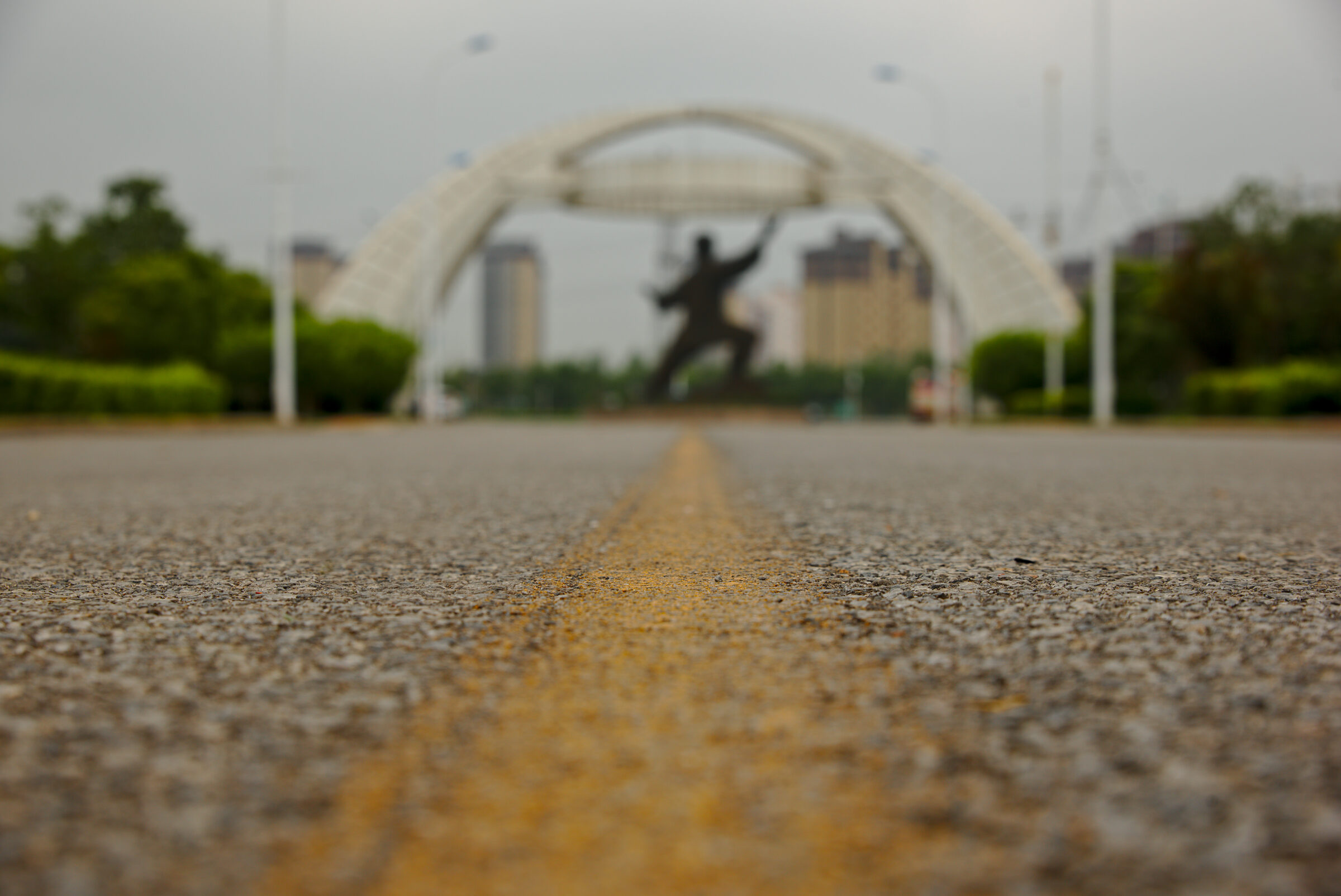
It’s huge. There’s a great paved square with flags along its edges, and at the far end a Huo Yuanjia carved in stone, enormous, looking out over all that empty space. I stood next to him and got the photo. I’m the small blue thing at the bottom right, which feels about the right proportion.

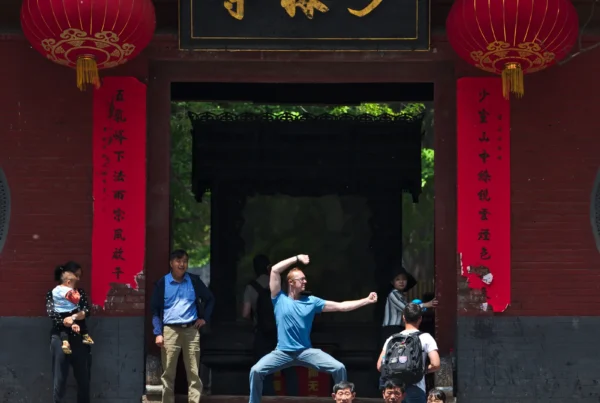
Around the square there were gardens with statues of fighters caught mid-form, and I did what any grown man with twenty-odd years of martial arts behind him would do, and joined in.


史
The fights that never happened
Inside there’s a museum of his life, and the real Huo Yuanjia turns out to be odder than the film. The two foreign challengers he’s famous for facing down both backed out. A Russian wrestler who’d been challenging Chinese fighters in Tianjin in 1901 withdrew and apologised in the local paper, and an Irish boxer called Hercules O’Brien left Shanghai in 1909 before the fight could happen. In Fearless, Jet Li fights O’Brien in front of a packed crowd and wins. The real O’Brien had left town before it started.

What he did do was go to Shanghai and start the school that became the Jingwu Athletic Association, one of the first attempts to teach the martial arts openly, as a modern discipline. A few months later, in 1910, he was dead at forty-two. Nobody knows for certain what killed him, and the rumour was poison. Bruce Lee picks the story up at his funeral in Fist of Fury, some sixty years later, and the legend has been doing his fighting for him ever since.
武
An injection of kung fu
I’d come to Tianjin for the lèitái and found a commute, and I’d stopped minding years before. But walking back across that empty square, I felt like I’d had an injection of the thing that brought me to China in the first place: a few hours in the company of the man who’d sent me there, and some kung fu in a very ordinary life.
That’s what I took home. The thing that brings you somewhere won’t come and find you on the way to work. You have to take the taxi out to the edge of the city, and make enough noise at the booth for someone to let you in.